The moment a company acknowledges it is in trouble almost always comes too late. On average, by 12 to 18 months. By then, the room to manoeuvre is limited, cash has run out, and stakeholders have become so rigid that every solution costs far more than it needed to. The crucial question is: how do you make sure you act in time to turn the tide?
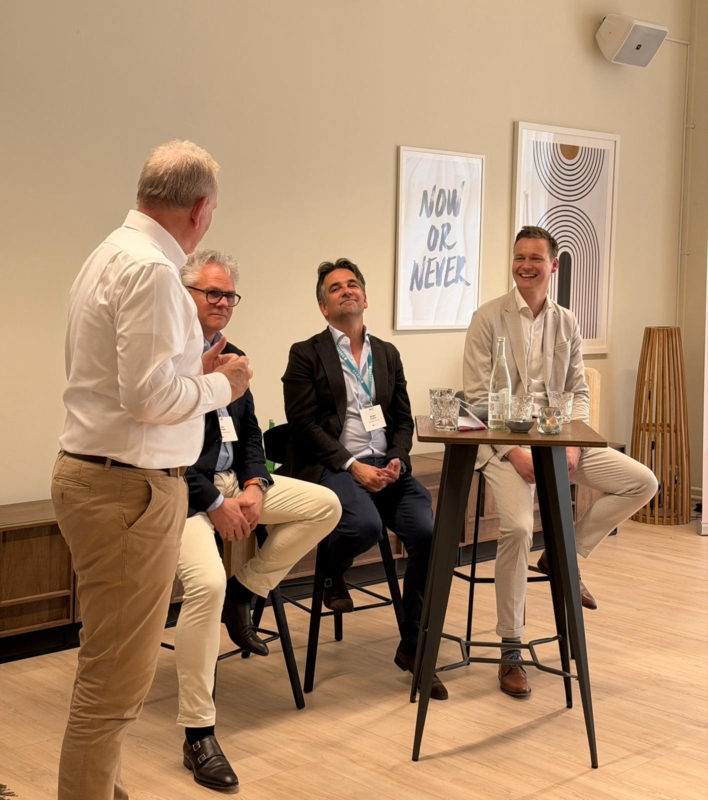
On 23 April, Greyt and EYnovation hosted the event Restructuring Ready: The Art of Timely Intervention. Turnaround specialist and INSEAD professor Joost de Haas delivered a mini masterclass, followed by a panel discussion featuring three experts:
- Sándor Sepsanie: Head of Financial Restructuring & Recovery at ABN AMRO
- Ynze Talstra: Partner Corporate Law, Insolvency & Restructuring at TRIP Advocaten Notarissen
- Pim Honig: CEO of Clean Solutions Group Nederland BV, an entrepreneur who has led multiple turnarounds in practice
Why do companies get into trouble?
“New legislation changed everything for us.” “The market has shrunk.” “Competitors are dumping prices.” These are the kinds of explanations often given by companies running into trouble. And while external factors certainly play a role, the real cause is almost always internal. What we would rather not hear, but what is almost always true, is that the root cause can usually be traced back to the quality of management. Research confirms this time and time again: management-related issues are the leading cause of financial distress in 73% to 84% of cases.
According to Joost de Haas, this is a familiar pattern: “The most optimistic people get promoted. You rarely see a pessimistic CEO. It doesn’t fit the image of visionary leadership. But once you’re in that role, it becomes incredibly difficult to admit that your strategy is not working. You keep hoping things will improve, but hope is not a strategy.”
Timing determines everything but when is the right moment?
Recognising there is a problem in time is the first step. But what counts as early enough? The earlier you intervene, the more options remain available. But communicating too early can create panic, damage confidence, and drive customers towards competitors. Intervening too late leaves you with little room to act.
So what determines how much time you actually have? The short answer: cash. A company facing strategic challenges but still holding years of liquidity has fundamentally more room to manoeuvre than a business that cannot pay salaries in three weeks’ time. In the first scenario, there is space for visionary leadership and a new direction. In the second, you need someone to take the wheel and say: we are turning left. Now!
“When liquidity problems become truly severe, part of your toolbox is already gone,” says Sepsanie. “Start early, because that’s when you still have options.” The later you act, the more expensive every solution becomes.
So where do the early warning signs appear? Not just in the numbers. “Go onto the work floor,” says De Haas. “Employees already know. They’ve already lost that customer, or they can already see margins shrinking.” Look at customer behaviour too: smaller order sizes, clients leaving, extended payment terms. These are not administrative details. They are early indicators of a business beginning to slide.
Restructure or stop: what are your options?
The moment it becomes clear a company is in serious trouble, one question takes centre stage: is there still value left to save? The first honest assessment is this: does the company still have a realistic path to standing on its own again? If not, shutting down may sometimes be the better option.
But if the answer is to continue, the challenge changes. Restructuring is rarely about saving the company itself. It is about deciding who absorbs which losses. The conversation shifts from “how do we improve performance?” to “how do we divide the remaining value?” That is exactly where tension arises between shareholders, banks, and other stakeholders.
De Haas summarised this dynamic with a sharp observation: “If you owe the bank €100, that’s your problem. If you owe the bank €100 million, that’s the bank’s problem.” Suddenly, parties that usually have little influence can become decisive. And stakeholders you once considered natural allies may unexpectedly find themselves sitting on the other side of the table.
The interests around the table: who does what in a restructuring?
A restructuring is a negotiation between parties, each protecting their own interests. Understanding who is sitting at the table is just as important as the financial plan itself.
Talstra warns shareholders: “A shareholder should never step into the role of management. The moment they do — even without an official title — they fall under the same liability regime as a statutory director.” Guide where necessary, but leave management with its own responsibility.
Sándor Sepsanie sees a positive shift in the relationship between banks and distressed companies: “Over the past 15 years, the relationship between banks and companies in distress has become more constructive. Less dictating, more working together towards a solution.” Pim Honig adds a practical nuance: transparency works, but in moderation. Being too open with a bank at an early stage can unintentionally trigger an escalation process that quickly moves beyond your control.
One thing all parties agreed on: collaboration is not a luxury, but a necessity. In the end, everyone around the table has to be willing to give something up.
What makes a turnaround successful?
The honest truth: most turnarounds fail. Roughly 75% do not succeed, almost always because intervention came too late. But in the cases that do succeed, clear patterns emerge.
- Start with cost control, only then focus on growth. Costs are within your control; revenue is determined by your customer. According to De Haas, there is often a deeper misconception underneath this: companies treat fixed costs as though they are truly fixed, while that is often exactly where the opportunity lies to make an organisation viable again.
- Make sure the operational and financial plans go hand in hand: a bank cannot support a recovery without a credible turnaround plan.
- Communicate differently with different stakeholders: your bank already knows a great deal, while your supplier may only know what they have read in the newspaper. Those conversations require different approaches, where transparency is a tool, not a goal in itself.
The value of early financial leadership
Financial distress rarely appears overnight. The warning signs are often there much earlier. They are simply recognised or voiced too late. That is exactly why early financial insight is so crucial. Not as an administrative function, but as a strategic instrument to identify risks long before others recognise them.
It requires financial leaders who are willing to speak up about what may be coming and who can bridge the gap between investors, management teams, and lenders. Or, as Joost de Haas concluded at the end of the evening: “Never waste a good crisis.”